Guide to choosing the right tools in AI (part II)
Selecting AI tools to solve real world problems
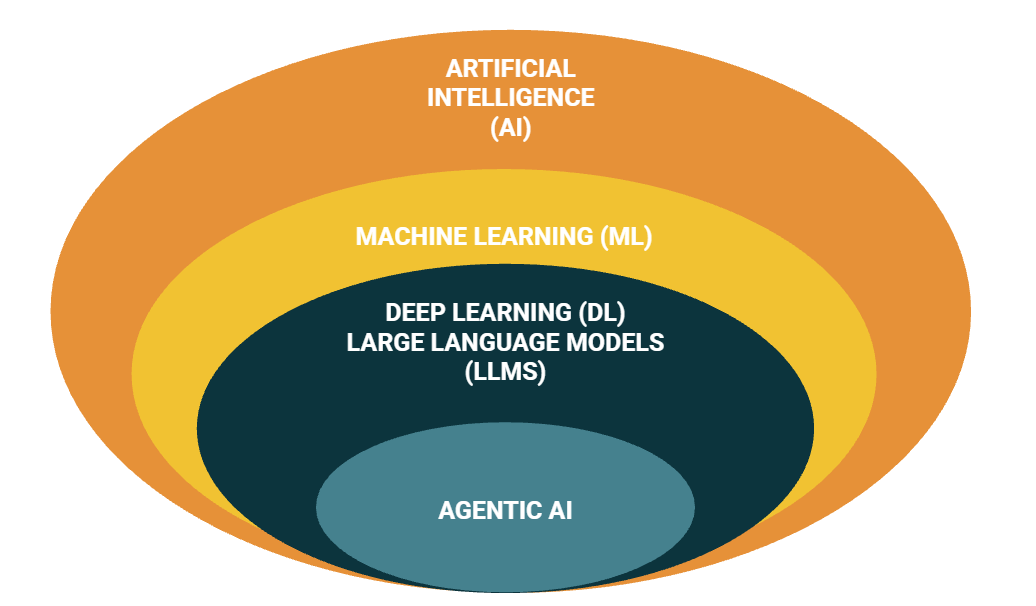
In Part I we covered the theoretical background in Artificial Intelligence, where we presented fundamental concepts in Machine Learning (ML), Deep Learning (DL) and the connection to Large Language Models (LLMs) and agentic AI. In this part, we turn to the practical question, given a task, which of these tools should you actually reach for?
We remind that we leave out any discussions on agentic coding as often those tools are an integral part of many development environments.
AI in industry
As we noted in Part I, most AI systems build on classical machine learning and deep learning. Examples include recommendation systems, fraud detection systems, image recognition, forecasting, and much more. What separates classical approaches from LLMs and agentic AI is the type of data they work best with and the nature of the tasks they are suited for. Tasks with well-defined and clear success criteria tend to be better suited to classical ML/DL techniques, which are also generally easier to evaluate in terms of performance and ROI.
The importance of data format
Furthermore we made the point that classical ML works best for structured and well-defined data. Often data is represented as tables with rows and columns with numeric or categorical values. In contrast, LLMs and agentic AI are better suited for unstructured data, such as text, images, and audio. Unstructured data can be modelled as a knowledge graph (KG) or processed using natural language processing (NLP) techniques to extract meaningful information.
Example: RAG and knowledge graphs
One common way to work with agentic AI is to build a Retrieval Augmented Generation (RAG) system, which combines the capabilities of LLMs with external or internal knowledge sources to provide more accurate and contextually relevant responses. A technique to improve a RAG system is to model the data sources as a knowledge graph (KG), which allows for better organization and retrieval of information based on relationships between entities. The agent can then produce more accurate and contextually relevant responses by leveraging the structured information in the KG. For example, the model can first identify entities in your data through named entity recognition (NER), then use the KG's explicit relationships to perform classification and link prediction more reliably than it could from raw text alone.
Example: Agentic AI in internal operations
Internal work in the form of authoring documents, creating reports, and managing internal communications can greatly benefit from agentic AI. LLMs can assist in drafting text, summarizing information, and generating insights from unstructured data, while agentic AI can help automate repetitive tasks and orchestrate workflows across multiple systems. These tasks are considered less well defined than the structured tasks classical ML handles. Drafting and summarizing carry low risk if wrong, but automating a workflow across multiple systems can lead to mistakes that can propagate and compound, which is why agentic systems still need guardrails.
Example: AI in the energy sector
The energy industry is an important and complex sector with many challenges ahead, including geopolitical, environmental and economic factors. Many tasks in the energy sector involve the use of time series data, such as measurements of energy consumption, production data, market prices, weather data etc.
Time series data can be stored in structured tables as numerical or categorical values. These datasets often have very large historical records, which is useful for training classical ML models effectively. For time series data, specialized models such as ARIMA, Prophet, neural networks or transformers (the building blocks in LLMs, often untrained) can be employed to capture temporal dependencies and make accurate forecasts.
Energy companies also work with unstructured data, such as news articles and market reports, where LLMs and agentic AI can help extract sentiment and surface signals that feed into the same forecasting pipeline. We'll dig deeper into these industry specific patterns in Part III.
Data, compute, and when to reach for classical ML
The most important component when creating AI systems is access to good quality data. The more data you have, the better your AI system will perform. However, it is important to note that not all data is created equal, and the quality of the data is just as important as the quantity. In addition to data, AI systems also require significant computational resources, including powerful GPUs and specialized hardware for training and inference (prediction).
We've noted that agentic AI isn't the right tool for every problem, so what should you reach for instead? The answer is classical machine learning and deep learning, algorithms and smaller neural networks that are well suited for structured data, such as tabular data, and can be used for tasks such as classification, regression, and clustering etc. Small neural networks can often be trained on local GPUs without the need for large scale distributed training, making them more accessible to smaller organizations and individuals.
Below we present a small sample of the tasks where classical ML, LLMs, and agentic AI can be applied. The table is not exhaustive, but it provides a good overview of the different capabilities of AI. Part III will build on this by walking through the same breakdown across specific industries.
Task Categories
The table below shows, task by task, which of classical ML, LLMs, or agentic AI is best suited. The categories include structured/tabular prediction, time series forecasting, anomaly/fraud detection, computer vision, text classification, information extraction, open-ended reasoning/synthesis, code generation, conversational interfaces, recommendation systems, search/ranking, scientific/numerical modeling, process automation (multi-system workflows), and research/investigation tasks.
| Task Category | Classical ML/Deep Learning (smaller neural networks) | LLM (single-turn/generative) | Agentic AI |
|---|---|---|---|
| Structured/tabular prediction | Yes | N/A | Agent can orchestrate a classical model as a tool, not replace it |
| Time series forecasting | Yes | N/A | Agent can call a forecasting tool + explain/act on results |
| Anomaly/fraud detection | Yes | Explains flagged cases | Agent investigates an anomaly: pulls logs, cross-references systems, drafts incident report |
| Computer vision | Task specific models | VLMs for zero-shot | Agent chains vision model output, decision, action (e.g., "if defect detected, file ticket + notify") |
| Text classification (fixed schema, high volume) | Yes | Costly at scale | Overkill, no multi-step behavior needed |
| Information extraction (varied schemas) | Narrow only | Good | Agent handles extraction + validation + follow-up lookups across sources |
| Open-ended reasoning/synthesis | N/A | Yes | Only if it requires multi-step research/tool use |
| Code generation | N/A | Single functions/snippets | Yes: writes code, runs tests, fixes failures, iterates |
| Conversational interfaces | Intent classification for rule-based bots | Q&A, simple chat | When the assistant needs to take actions (book something, query a DB, update a CRM) |
| Recommendation systems | Yes, at scale | Cold-start reasoning | Agent could dynamically research a user's context, but rarely worth the latency/cost |
| Search/ranking | Learning to rank | Semantic retrieval (RAG) | Agentic RAG: iterative query reformulation, multi-hop retrieval, cross-checking sources |
| Scientific/numerical modeling | Yes | N/A | Agent + tool use (code execution, simulation calls) can do numeric work reliably; raw LLM can't |
| Process automation (multi-system workflows) | N/A | Can draft steps | Agent coordinates and executes across systems, the core new capability agentic AI adds |
| Research/investigation tasks | N/A | One-shot summary of given context | Yes: searches, reads, cross-references, synthesizes across many sources autonomously |
The pattern to take away from this table is that agentic AI rarely replaces classical ML or deep learning on well defined, high volume, single step tasks; those stay cheaper, faster, and more predictable with a purpose built model. Agentic AI earns its cost on tasks that require multiple steps, judgment calls, or pulling information from several disparate sources before producing an answer or taking an action.
Comparison of Concerns
Choosing a tool isn't just about capability, it also means signing up for a different set of operational concerns. The table below summarizes how evaluation, failure modes, cost, latency, and guardrails differ across the three approaches.
| Concern | Classical ML/Deep Learning (smaller neural networks) | LLM | Agentic AI |
|---|---|---|---|
| Evaluation | Held-out test set, standard metrics | Human eval, benchmark suites | Task success rate, trajectory quality, cost-to-completion, much harder to evaluate |
| Failure mode | Wrong prediction | Wrong/hallucinated output | Can compound errors across steps, get stuck in loops, take irreversible actions |
| Cost | Fixed inference cost | Per-token cost | Variable, potentially unbounded (many LLM calls per task) |
| Latency | Milliseconds | Seconds | Seconds to minutes (sequential tool calls) |
| Guardrails | Input validation | Content filtering | Permission boundaries, action confirmation, sandboxing |
The common thread here is that each step up in autonomy trades predictability for capability. Classical ML fails in a bounded, measurable way. An LLM can hallucinate but the consequence is a single wrong answer, an agent can chain a series of individually reasonable actions into an unintended outcome, and can take irreversible actions in the process. This is why agentic systems need permission boundaries and action confirmation as a default, not an option to take later on, especially anywhere they can write to a system of record.
In Part III, we'll apply this framework to specific industries, including manufacturing and energy, which is most relevant to Helicon's own work.
