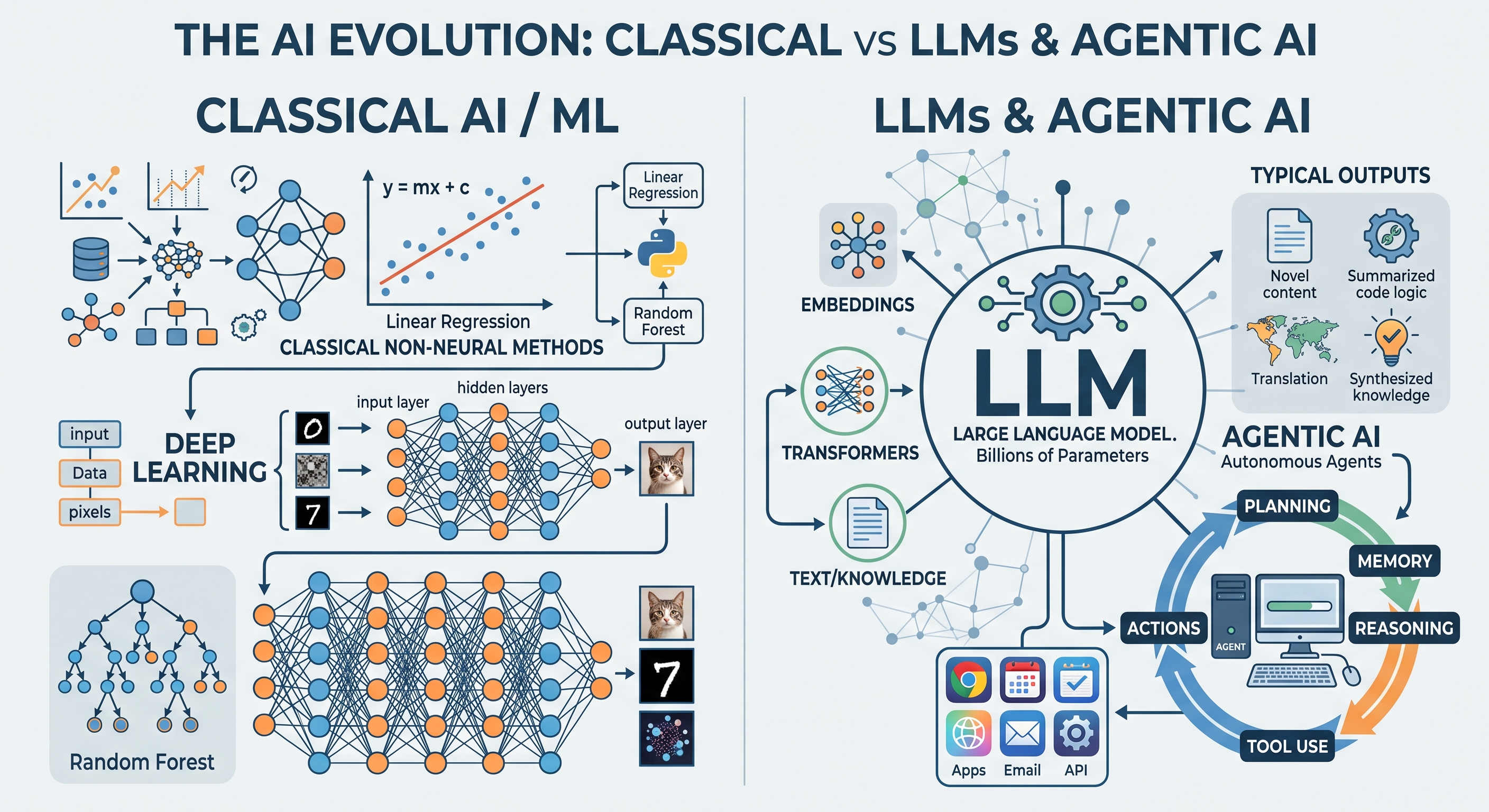
Classical ML, deep learning, LLMs, and agentic AI: The practical tradeoffs Are you responsible for helping your organization implement AI solutions, but unsure which tools to use? This guide walks through the differences between classical machine learning, deep learning, large language models (LLMs), and agentic AI.
This is the first part of a series. Part I covers the landscape and the tradeoffs worth knowing before you commit to a tool, Part II matches tool types to task categories, Part III walks through applications across industries.
The AI landscape Classical machine learning (ML) and deep learning (DL) are algorithms and tools that have been in production the longest in many organizations and industry. Classical ML models are trained on your own data for a specific, well-defined task like classification, regression, anomaly detection, forecasting and much more. Well defined tasks with well structured data are the kind of problems suitable for classical ML.
Because a classical ML or DL model is trained for one task on your own data, its behavior is narrow and predictable. The same input structure in, the same kind of output out, at a fixed and usually low inference cost. That's the tradeoff against an LLM, you give up general-purpose flexibility (an LLM can be repointed at a new task with a different prompt, no retraining needed) in exchange for a model that's cheaper, faster, and easier to evaluate against a held-out test set.
The biggest value of classical ML comes from the fact that the results can be evaluated in a much simpler manner with well defined metrics which makes the system more trustworthy, on the other hand, the evaluation of Agentic AI is much complex and often requires deep domain knowledge. It's also why ML models still handle the bulk of production AI workloads even in an LLM-heavy world, most business problems are actually narrow, repeated tasks, exactly what classical ML and smaller DL models are built for.
AI-harnessed LLMs and agentic AI LLMs are deep learning models (transformer architectures, trained on huge amounts of text) that generate human-like text in response to a prompt. What's newer is what gets built on top of them, an LLM that's been given tools to call, and rules or scaffolding around how it uses them, becomes an agent, and a system of that kind is what people mean by agentic AI.
The scaffolding is often called an AI-harness, since no amount of training covers every scenario an LLM might encounter, the harness acts as a safety net, constraining what the model can do and catching cases where its judgment isn't reliable enough to trust unsupervised.
One category we're deliberately leaving out of this series is agentic coding tools (Claude Code and similar). By now these are closer to infrastructure for anyone writing software than a strategic choice to weigh, so we won't spend time on them here.
What actually shapes the decision Cost is less predictable than it looks . Running your own classical model has a roughly fixed inference cost. LLM and agent costs are usage-based and can scale unpredictably, an agent might make many LLM calls to complete a single task. On top of that, nobody outside the major labs really knows the true cost of running these models at scale: electricity, hardware, and data center costs are rarely disclosed, which makes today's API pricing hard to treat as a stable baseline for planning.
Regulation is still catching up . AI-specific regulation is evolving quickly and unevenly across jurisdictions. If you're calling a third-party API, you're also implicitly relying on that provider's country's laws, which may not align with the compliance requirements your own organization has to meet. This matters most when the data you're sending is sensitive, make sure you understand what happens to it once it leaves your systems.
Open source vs. closed source is a control tradeoff, not just a capability one. Closed-source LLMs tend to be more powerful and trained on larger datasets, but you're trusting a third party with your data and your uptime, and you inherit their regulatory exposure. Open-source LLMs can be self-hosted, which gives you direct control over where your data goes and how the model is secured, at the cost of needing more in-house technical expertise and typically weaker out-of-the-box capability.
Open source LLMs can be both a blessing and a curse, first training data is often not disclosed, which makes it hard to know what biases the model might have learned. Second, the model can be fine-tuned on your own data, but that requires expertise and infrastructure. Third, open source LLMs are often less capable than closed source models, which means you may need to build more scaffolding around them to get the same results. A combination might be the right answer, for example, using a closed-source LLM for the heavy lifting, but an open-source model for sensitive data that can't leave your systems.
Match the tool to the task . It's easy to reach for the most capable tool available, but capability doesn't mean fit. If your task has a fixed input/output structure, enough historical data to train on, and success can be measured with a clear metric, classical ML is usually the better choice, cheaper to run, easier to evaluate, and its failure modes are far more predictable than an LLM's. Reach for an LLM or agent instead when the task itself is unstructured, the rules for solving it change often, or you don't have labeled data to train a dedicated model on. We come back to this split directly in Part II.
Keep these considerations in mind as you read the rest of the series, they should shape not just which tool you pick for a given task, but how much oversight and infrastructure you build around it once you do.
